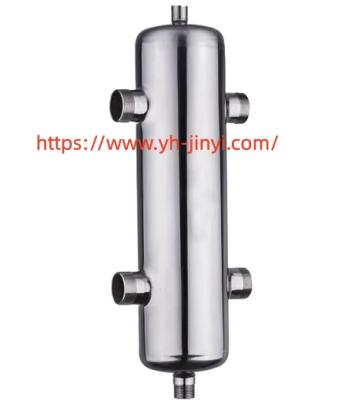
How Jinyi Hydraulic Separator Tank Changes HVAC Flow Behavior i
-
Jinyi Hydraulic Separator Tank sits in a part of the HVAC system that usually does not get much attention, but once it is in place, the behavior of the whole loop starts to feel different. Not louder, not more complex, just calmer in a way that engineers notice during commissioning and later during day to day operation.
In a typical multi zone building, circulation is rarely steady. One floor asks for cooling while another still needs heating, and the system ends up negotiating with itself. Pumps react, flows shift, and the balance starts to drift. That is where separation changes the dynamic. It gives each side of the system a bit of breathing room so they are not constantly pushing against each other.
Once that pressure conflict is reduced, flow starts to behave in a more predictable pattern. You can see it in how quickly temperatures settle after a load change. Instead of chasing corrections, the system finds a steadier path. That does not mean everything becomes static, it just means the swings are less sharp and easier to manage.
There is also a practical side that shows up in maintenance logs. When circulation is unstable, small spikes in pressure tend to accumulate stress in valves, joints, and pump assemblies. Over time that creates noise in the system, both literally and in terms of troubleshooting. With separation in place, those spikes are softened, and the system stops sending so many sudden signals to react to.
Energy behavior shifts too. When pumps are constantly compensating for interference between loops, they end up working harder than the load actually requires. Once that interference is reduced, output feels less forced. The system does not need constant correction, it just adjusts in smaller steps that match real demand more closely.
In larger buildings, especially mixed use spaces, this becomes even more noticeable. Different zones never really agree on demand, and without separation, that disagreement turns into inefficiency. With it, the disagreement still exists, but it no longer spreads through the whole network. It stays contained where it belongs.
Engineers often describe this kind of setup as giving the system a neutral zone. Not a dramatic change, just a buffer where flow can reset itself before moving on. That small buffer is what keeps multi loop designs from becoming overly sensitive when conditions shift quickly.
As building systems continue to grow in size and complexity, that kind of stability becomes less of a luxury and more of a design requirement. Not because it solves everything, but because it keeps everything else from spiraling out of balance.
More practical configuration details and related components can be viewed at https://www.yh-jinyi.com/product/ where system layouts and application examples are presented in a straightforward way for engineering reference.